When Claude Monet gazed upon a Japanese print for the first time in the 1860s, little did he know that this moment would forever transform his artistic vision. The influence of Japanese art on Monet wasn’t just a passing fancy—it became a fundamental shift that would reshape Western painting forever. This unexpected cultural exchange between 19th-century France and Japan created one of the most fascinating artistic dialogues in history.
The story begins with the sudden opening of Japan to Western trade in 1853. Within years, Japanese woodblock prints—known as ukiyo-e—flooded European markets. These affordable artworks depicted everyday scenes, landscapes, and courtesans with a freshness and perspective that shocked European artists. For Monet, who would become the movement’s most devoted practitioner, these prints offered something revolutionary: a new way of seeing the world.
Monet’s First Encounter with Japanese Aesthetics
Monet discovered Japanese prints through his close friend and fellow artist Édouard Manet. The bold compositions, unusual viewpoints, and vibrant colors of ukiyo-e masters like Hokusai and Hiroshige captivated him immediately. Unlike the formal academic training he received in France, Japanese art celebrated spontaneity and direct observation of nature.
The French called these prints “japonaiserie,” and they became wildly popular among artists. Monet began collecting them voraciously, eventually amassing over 200 pieces. He hung them throughout his home and studio, studying their techniques obsessively. The influence was immediate and profound—his paintings began showing flatter perspectives, cropped compositions, and a new sensitivity to pattern and design.
The Garden at Giverny: A Living Japanese Canvas
Perhaps nowhere is Monet’s love for Japanese art more evident than in his magnificent garden at Giverny. In 1883, he rented a house with extensive grounds in Normandy. By 1890, he owned the property and began transforming it into what he called his “most beautiful work of art.”
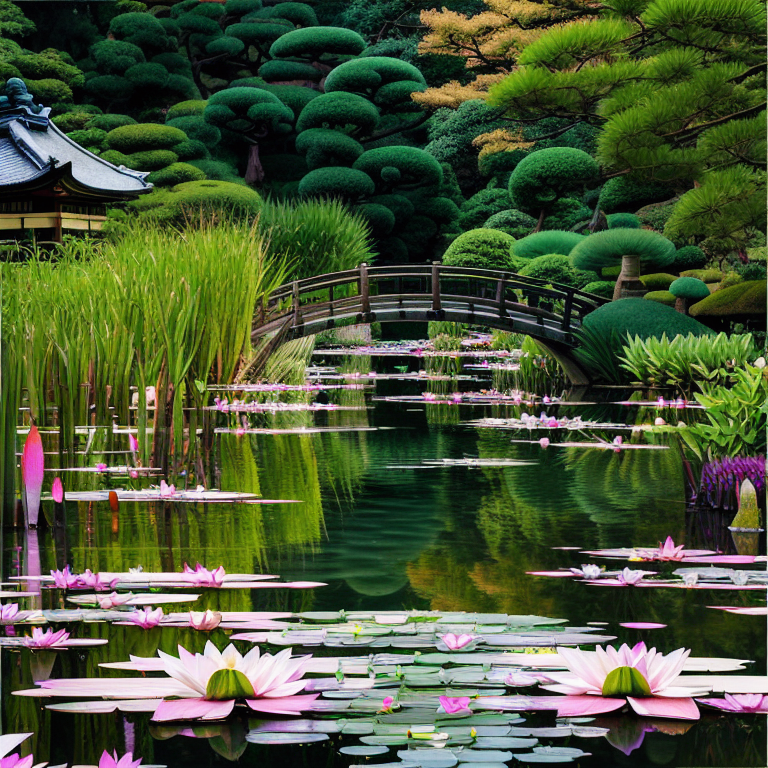
The centerpiece was the iconic Japanese bridge, draped in wisteria and reflected in the pond below. This wasn’t mere decoration—it was a direct homage to the Japanese landscapes he admired. Monet carefully selected water lilies from South America and Egypt, creating the floating gardens that would become the subject of his most famous series. The curved bridge, the diagonal paths, and the careful arrangement of plants all reflected Japanese compositional principles.
Breaking Western Perspective Rules
One of the most significant ways Japanese art influenced Monet was through perspective. Traditional Western painting relied on linear perspective, creating depth through converging lines. Japanese artists, however, often used elevated viewpoints, bird’s-eye perspectives, and compositions that ignored conventional rules of space.
Monet embraced these techniques wholeheartedly. In works like “The Japanese Footbridge,” he abandoned traditional perspective entirely. The bridge arcs dramatically across the canvas, while water lilies float in the foreground without clear spatial relationships. This flattening of space wasn’t just stylistic—it was philosophical, suggesting that all elements in nature held equal importance.
Color Revolution: Beyond the Western Palette
Japanese prints introduced Monet to a bolder, more experimental approach to color. Ukiyo-e artists used vibrant, sometimes unnatural colors to capture mood and atmosphere rather than literal representation. This aligned perfectly with Monet’s growing interest in capturing the ephemeral qualities of light.
His series paintings—haystacks, poplars, and especially water lilies—show this Japanese-inspired color sensibility. He painted the same subject under different lighting conditions, using color to convey time, season, and emotion. The water lily paintings, with their dreamlike purples, blues, and greens, seem to float between reality and imagination, much like Japanese landscapes that prioritized feeling over precision.
The Art of Everyday Beauty
One of the most profound influences of Japanese art on Monet was the elevation of everyday subjects. Ukiyo-e prints celebrated ordinary life—geisha walking through cities, fishermen at work, simple domestic scenes. This philosophy of finding beauty in the mundane resonated deeply with Monet.
His garden paintings, haystacks, and Rouen Cathedral series all demonstrate this Japanese principle. Rather than painting grand historical scenes or mythological subjects (as academic tradition demanded), Monet found infinite variation in the ordinary. A haystack under morning light became as worthy of contemplation as any royal portrait. This democratization of subject matter was revolutionary.
Brushwork and the Spirit of Spontaneity
Japanese art’s emphasis on quick, expressive brushwork also transformed Monet’s technique. Ukiyo-e prints, created through a meticulous process of carving and printing, nonetheless conveyed a sense of immediacy and vitality. Monet adapted this energy to his oil paintings, developing the loose, visible brushstrokes that became characteristic of Impressionism.
His later works, particularly the water lily murals at the Musée de l’Orangerie in Paris, show this influence most clearly. The massive canvases swirl with energetic marks that seem to dance across the surface. Up close, they appear abstract and chaotic, but from a distance, they resolve into luminous water gardens. This approach mirrors the Japanese concept of capturing the essence or spirit of a subject rather than its exact appearance.
The Global Art Exchange
The influence wasn’t one-directional. Just as Japanese art transformed Western painting, Western interest helped revive traditional Japanese printmaking techniques. Artists in both cultures began studying each other’s methods, creating a rich cross-pollination of ideas.
Monet’s success also inspired other French artists to explore Japanese themes. The entire Impressionist movement felt this influence, though Monet remained its most devoted Japanese art enthusiast. His work demonstrates how cultural exchange can lead to entirely new artistic languages.
Monet’s Legacy: A Bridge Between Worlds
When Monet died in 1926, he left behind not just beautiful paintings but a new way of seeing. His Japanese-inspired works taught Western audiences to appreciate subtlety, pattern, and the beauty of everyday moments. The influence extended far beyond painting—it affected garden design, architecture, and decorative arts.
Today, visitors to Giverny can walk through Monet’s living Japanese canvas, crossing the green bridge and watching water lilies drift across the pond. The experience connects us to that moment in the 1860s when a French artist first encountered Japanese prints and saw the world anew.
Frequently Asked Questions
What specific Japanese artists influenced Monet the most?
Hokusai and Hiroshige were Monet’s primary influences. He particularly admired Hokusai’s “Thirty-Six Views of Mount Fuji” series and Hiroshige’s landscape prints. These artists’ innovative compositions and treatment of natural subjects directly inspired Monet’s approach to painting.
Did Monet ever visit Japan?
No, surprisingly, Monet never traveled to Japan despite his deep appreciation for Japanese art. He experienced Japanese aesthetics entirely through prints and artifacts available in France. This makes his interpretation purely visual rather than experiential, which may explain why his “Japanese” works feel more like French dreams of Japan than authentic representations.
How many Japanese prints did Monet own?
Monet collected approximately 200 Japanese prints throughout his lifetime. He displayed them throughout his home at Giverny and continued acquiring new pieces until his death. His collection included works by nearly all the major ukiyo-e artists of the 19th century.
How did Japanese art influence Monet’s painting technique?
Japanese art influenced Monet’s technique in several ways: he adopted flatter perspectives, used more vibrant and unconventional color combinations, developed looser brushwork, and began cropping his compositions in ways that felt more spontaneous and modern. The influence can be seen most clearly in his water lily series and garden paintings.
Why did Japanese art become so popular in 19th-century France?
Japanese art became popular in France after the 1853 opening of Japan to Western trade ended 200 years of isolation. The sudden availability of affordable, exotic artworks fascinated European artists and collectors. Japanese aesthetics offered a fresh alternative to academic traditions, emphasizing beauty in everyday subjects and innovative compositions.
How is Monet’s Japanese bridge different from actual Japanese bridges?
Monet’s bridge at Giverny is a romanticized interpretation rather than an authentic Japanese design. While it incorporates Japanese elements like the curved shape and simple wooden construction, it’s adapted for a European garden context. The bridge serves more as a symbolic reference to Japanese art than a faithful reproduction.
What other Western artists were influenced by Japanese art?
Many artists felt Japanese influence, including Vincent van Gogh (who painted his own version of Hiroshige’s prints), Edgar Degas, Mary Cassatt, and James McNeill Whistler. The entire Art Nouveau movement also drew heavily from Japanese design principles. For more on artistic influences, you might enjoy reading about how Van Gogh’s Starry Night contains hidden messages that reflect his artistic journey.
Conclusion
The influence of Japanese art on Monet represents one of the most beautiful examples of cross-cultural artistic exchange in history. What began as a fascination with exotic prints evolved into a complete transformation of how Western art could see and represent the world. Monet didn’t just borrow Japanese techniques—he absorbed their philosophy, their appreciation for nature’s fleeting beauty, and their belief that art should capture feeling rather than mere appearance.
His water lily paintings, Japanese bridge, and garden at Giverny stand as lasting monuments to this cultural dialogue. They remind us that great art often emerges from the meeting of different traditions, and that sometimes the most revolutionary ideas come from looking at the world through someone else’s eyes. Monet’s Japanese-inspired works continue to captivate viewers because they speak a universal language of beauty, one that transcends cultural boundaries while celebrating them.
The next time you stand before a Monet water lily painting or stroll across his green bridge, remember that you’re witnessing not just the vision of a French Impressionist, but the beautiful conversation between East and West that forever changed the course of art history.
If you’re inspired by how artists like Monet transform their surroundings into masterpieces, you might enjoy learning how to curate your own stunning art gallery at home, creating spaces that celebrate artistic vision and cultural exchange.
Leave a Reply