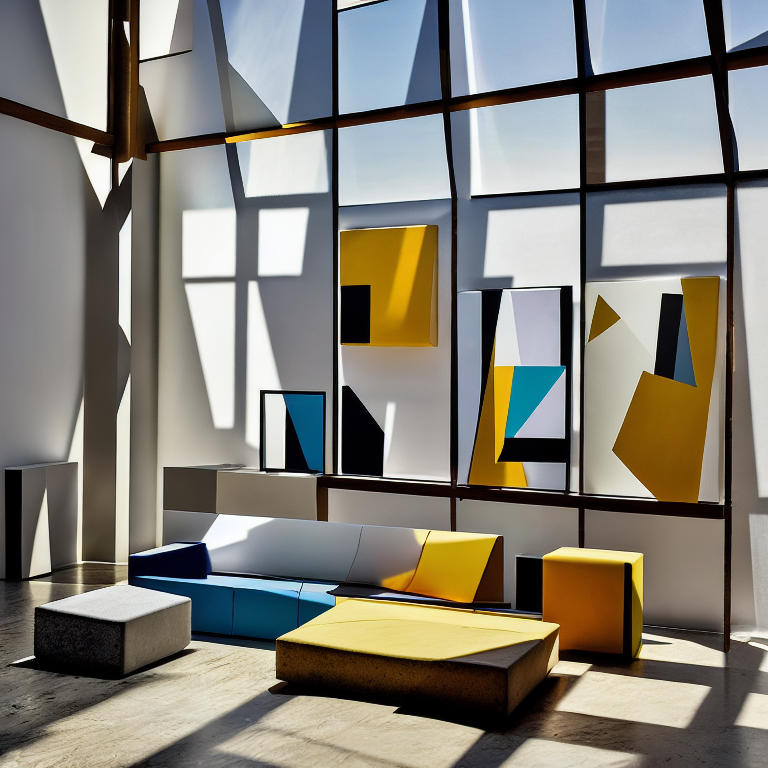
Pablo Picasso changed art forever when he created Cubism. This revolutionary style broke objects into geometric shapes and showed them from multiple angles at once. But how did he actually do it? What secret techniques made his cubist paintings so powerful and unique?
Picasso didn’t invent Cubism overnight. He developed his techniques through years of experimentation and careful study of other artists. The journey began around 1907 when he painted “Les Demoiselles d’Avignon,” a work that shocked the art world with its angular forms and African mask influences.
The Geometric Breakdown Method
Picasso’s first secret technique was breaking down objects into basic geometric shapes. He would look at a subject – say, a guitar or a human face – and mentally divide it into cubes, cylinders, spheres, and cones. This wasn’t random. He studied how light and shadow fell on these shapes in real life.
The key was simplification. Picasso reduced complex forms to their essential geometric components. A nose became a triangle, an eye a circle, a shoulder a curved rectangle. This geometric approach allowed him to show the structure beneath the surface appearance.
Multiple Viewpoint Composition
The second major technique involved showing multiple viewpoints simultaneously. Instead of painting an object from one fixed position, Picasso would depict it from several angles at once. A face might show both profile and frontal views merged together. A guitar could display its front, side, and interior all in one painting.
This technique challenged centuries of Western art tradition that emphasized single-point perspective. Picasso borrowed ideas from African and Iberian art, where figures often showed multiple aspects of the same subject. The result was a more complete representation of reality – not how something looks from one angle, but how it exists in space.
The Color Restriction Strategy
Picasso often limited his color palette in cubist works. During his “Analytical Cubism” period (roughly 1909-1912), he frequently used monochromatic schemes of browns, grays, and ochres. This wasn’t because he couldn’t use color well – he was actually a master colorist. The restriction served a purpose.
By limiting color, Picasso directed attention to form, structure, and the relationships between shapes. Color can be distracting, drawing the eye to surface appearances. Without strong color contrasts, viewers focused on the geometric construction and spatial relationships he was exploring.
Collage Integration Technique
Around 1912, Picasso began incorporating collage elements into his cubist works. He would glue newspaper clippings, sheet music, wallpaper, and other materials directly onto the canvas. This technique, called “Synthetic Cubism,” added new dimensions to his work.
The collage technique allowed Picasso to blur the line between reality and representation. A piece of newspaper glued to a painting was both itself and a representation of something else. This added conceptual depth to his work and influenced generations of artists who followed.
The Fragmentation Process
Picasso’s fragmentation technique involved breaking down forms into smaller and smaller pieces. He would take a simple object and divide it repeatedly until it became almost unrecognizable. Yet somehow, the essence of the original object remained visible.
This process wasn’t about destroying the subject but revealing its inner structure. By fragmenting forms, Picasso showed how objects exist in space and time. A portrait might show a face in different emotional states simultaneously, or a still life might display objects at various moments of use.
Perspective Manipulation Secrets
Traditional perspective shows objects smaller as they recede into space. Picasso deliberately manipulated perspective rules to create his cubist effects. He would make distant objects appear large and close objects small, or show objects from contradictory perspective viewpoints in the same composition.
This manipulation wasn’t random. Picasso understood traditional perspective perfectly – he used it deliberately to create tension and new ways of seeing. His perspective tricks forced viewers to engage actively with the painting, piecing together the multiple viewpoints into a coherent whole.
The Sketch and Study Method
Before creating major cubist paintings, Picasso made numerous preparatory sketches and studies. These weren’t just rough drafts but detailed explorations of how to break down and reconstruct his subjects. He would draw the same object dozens of times, each time simplifying it further.
This methodical approach shows that Picasso’s cubist style, while appearing spontaneous, was actually the result of careful planning and analysis. The sketches reveal his thought process as he worked out how to represent three-dimensional reality on a two-dimensional surface.
Material and Texture Experimentation
Picasso experimented extensively with different materials and textures in his cubist works. He would mix sand into his paint for rough textures, use different types of paper in collages, and even incorporate non-traditional materials like wood and metal.
These material experiments added another layer to his cubist explorations. The physical texture of the surface became part of the composition, creating a dialogue between the represented forms and the actual materials used to create them.
The Influence of African and Iberian Art
Picasso’s cubist techniques were heavily influenced by African and Iberian art he encountered in Paris museums and collections. He was particularly drawn to the simplified forms, geometric patterns, and multiple viewpoints in these works.
The African mask he saw at the Trocadéro Museum in Paris profoundly influenced “Les Demoiselles d’Avignon.” The mask’s stylized features and multiple perspectives inspired Picasso to break away from traditional Western representation and develop his own visual language.
Digital Age Connections
While Picasso worked long before digital technology, his cubist techniques have surprising relevance to modern digital art. His multiple viewpoint approach is similar to how 3D modeling software represents objects from various angles. His fragmentation technique resembles pixelation and digital deconstruction.
Contemporary artists continue to draw inspiration from Picasso’s cubist methods. Digital artists use software to create cubist-inspired works that would have been impossible in Picasso’s time, yet they’re building on the foundation he established.
Legacy and Contemporary Impact
Picasso’s cubist techniques continue to influence artists today. Contemporary painters, sculptors, and digital artists study his methods and adapt them to new media. His approach to breaking down and reconstructing reality remains relevant in an age of digital fragmentation and multiple perspectives.
The principles he developed – geometric simplification, multiple viewpoints, material experimentation – are now fundamental concepts in modern and contemporary art education. Every art student learns about cubist techniques as a crucial step in understanding modern visual language.
Frequently Asked Questions (FAQ)
What exactly is Cubism and how did Picasso develop it?
Cubism is an art movement that breaks objects into geometric shapes and shows multiple viewpoints simultaneously. Picasso developed it gradually between 1907 and 1914, influenced by African art, Cézanne’s paintings, and his own experiments with form and perspective.
How long did Picasso’s Cubist period last?
Picasso’s Cubist period spans roughly from 1907 to the early 1920s, though he continued to use cubist elements throughout his career. The movement is typically divided into “Analytical Cubism” (1909-1912) and “Synthetic Cubism” (1912-1914).
What materials did Picasso use for his Cubist paintings?
Picasso used traditional oil paints on canvas, but he also incorporated collage elements like newspaper, wallpaper, and sheet music. He experimented with different textures by mixing sand into paint and using various types of paper and other materials.
Why did Picasso use such limited colors in many of his Cubist works?
Picasso limited his color palette to focus attention on form, structure, and spatial relationships. By removing the distraction of strong colors, he could explore how shapes relate to each other in space more effectively.
How can I learn to paint in a Cubist style?
Start by studying basic geometric forms and how light affects them. Practice breaking down complex objects into simple shapes. Experiment with showing multiple viewpoints of the same subject. Study Picasso’s preparatory sketches to understand his process.
Did Picasso invent Cubism alone?
While Picasso is the most famous Cubist, he developed the style alongside Georges Braque. They worked closely together from 1907 to 1914, influencing each other’s work so much that sometimes their paintings were difficult to tell apart.
Conclusion
Picasso’s cubist techniques weren’t just artistic innovations – they were revolutionary approaches to seeing and representing reality. His geometric breakdown method, multiple viewpoint composition, color restriction strategy, and material experimentation created a new visual language that continues to influence artists today.
The secret behind Picasso’s cubism wasn’t magic or random inspiration. It was careful study, methodical experimentation, and a willingness to break rules. He understood traditional artistic techniques perfectly, which allowed him to deliberately subvert them and create something entirely new.
By studying these techniques, we can better understand not just Picasso’s work, but how art can challenge our perceptions and show us new ways of seeing the world around us. His legacy lives on every time an artist breaks down reality into fundamental forms and reassembles them in new and surprising ways.
Leave a Reply